
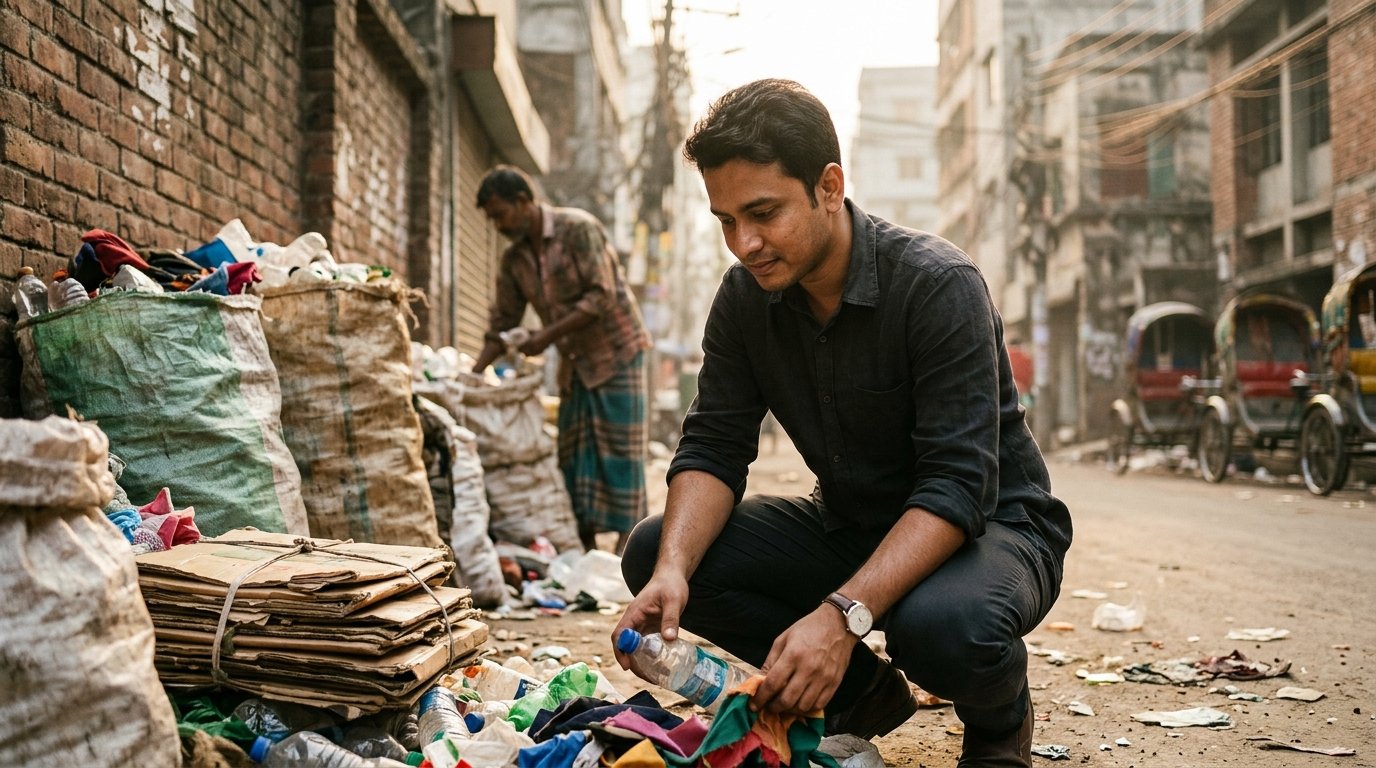
Early morning in Dhaka. You’re walking past a dustbin, a handkerchief pressed to your nose. At that very moment, someone is sorting bottles, paper, and tin cans from the same bin. To you, it’s garbage. To them, it’s breakfast.
Same thing, two sets of eyes. And in the world of business, every big opportunity is born from exactly this gap in perspective.
How Big Is the Problem?
According to the World Bank, the world generates about 2.01 billion tonnes of municipal solid waste every year, and that could climb to nearly 3.4 billion tonnes by 2050. The UN Food and Agriculture Organization (FAO) says roughly one-third of all food produced globally is lost or wasted. Yet on the same planet, hundreds of millions of people go to bed hungry.
Our own garment sector tells the same story. Fabric offcuts left after cutting, known as cut-offs, pile up by the hundreds of thousands of tonnes every year. One estimate puts the figure above five hundred thousand tonnes. All of it sits right in front of our eyes.
Those Who Turned Problems Into Products
Bio-bean (UK) collects used coffee grounds from cafés and turns them into fuel and biofuels. The coffee you finish and toss away? A whole industry has grown from its dregs.
Parley for the Oceans gathers plastic washed up in the sea. Adidas used that plastic to make shoes, now a well-known product line. Here, the waste itself is the brand story.
Our own Waste Concern showed a community-based model for making compost from Dhaka’s organic waste. The city got less garbage, farmers got fertilizer, and people got jobs. Three problems solved at once.
What Does the Big Picture Say?
An Accenture analysis suggests the circular economy could create around $4.5 trillion in economic opportunity worldwide by 2030. In other words, treating waste as a resource is no longer a niche idea. It is a vast market.
What Do These Stories Teach Us?
1. A problem is an unmet need. Wherever people are frustrated, a market is waiting.
2. Impact and profit are not opposites. A business that solves a social problem earns more trust and stronger customer loyalty.
3. You don’t need big capital to start. You need a big question. “Why are we throwing this away?” and “Who could use this?” have launched many entrepreneurs’ journeys.
No problem in this world is a permanent curse. For some it’s a burden, for others an opportunity. What makes the difference is the eyes of the person looking.
Next time you pass a dustbin, pause for a moment. Think about what’s lying there, and who has learned to see its value. Maybe your next big idea is waiting right there. If you had to pick one problem to solve starting today, which would it be?