

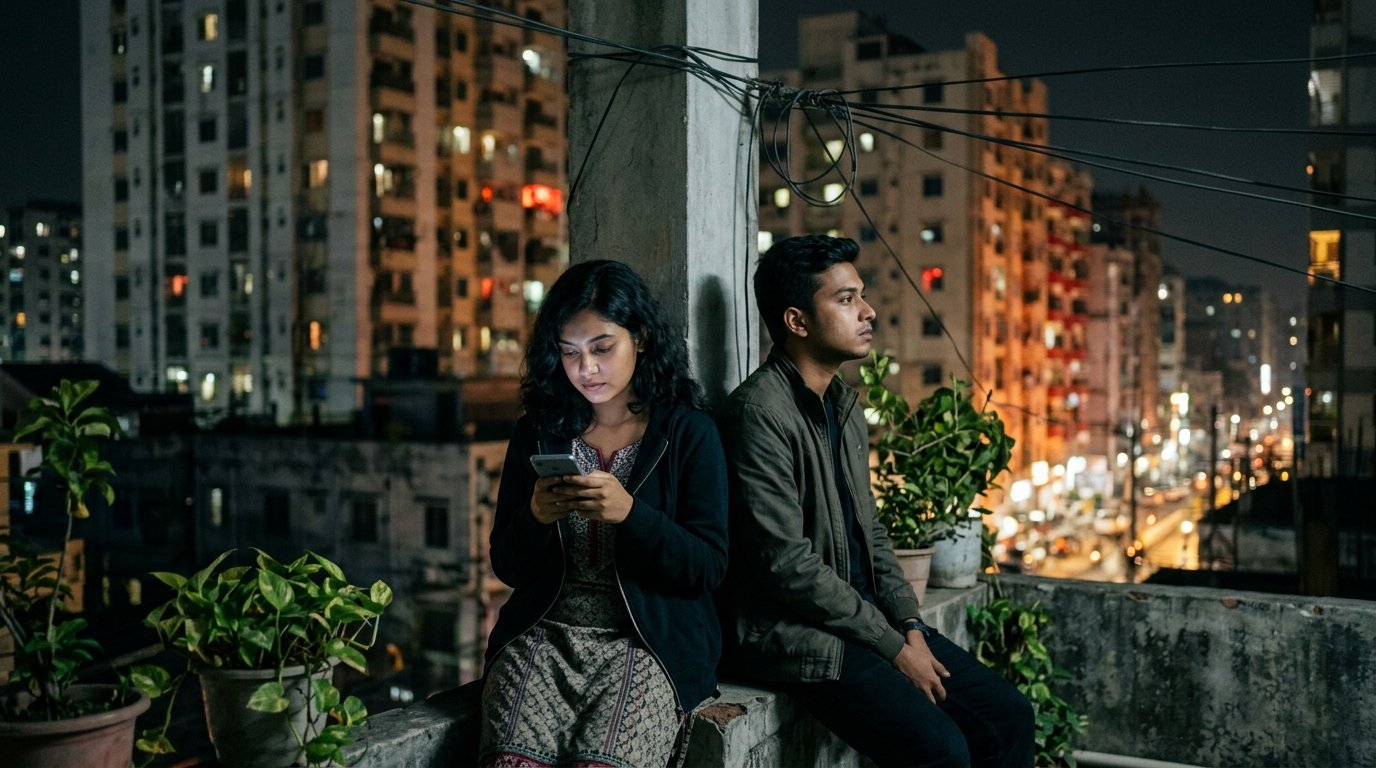
It’s one a.m. A name keeps lighting up your phone screen. You’ve talked all day, shared memes, even asked each other “Did you eat?” And yet nobody knows what to call this thing between you. When friends ask, you have one answer: “I don’t know… I guess something’s going on.”
That “something” now has a name: mebilationship (Maybe + Relationship).
So, what exactly is a mebilationship?
It’s not quite love, and it’s not just friendship either. Two people spend time like a couple, share emotions, and keep track of each other’s days. But the words “we’re in a relationship” never leave anyone’s mouth. There’s no commitment, no label, and no promise about the future.
A few familiar signs:
– You talk for hours, but the moment “What are we?” comes up, the topic changes
– Neither of you has met the other’s family or close friends
– It’s never certain whether you’ll see each other on Eid, a birthday, or any special day
– You both know, somewhere inside, that one of you is more invested
Is this only our story?
No. The word may be foreign, but the experience now belongs to Gen Z everywhere.
Researchers call this kind of connection a “situationship” or an “ambiguous relationship.” Scholars of relationship communication, including the American researcher Leslie Baxter and others, have studied relational ambiguity. The gist of their work: when the status of a relationship stays unclear, people feel more uncertainty, anxiety, and stress. The brain dislikes uncertainty. It keeps searching for answers: “Does she really like me?”
Another related body of research is on “hookup culture,” which found that a large share of young people feel more comfortable with flexible arrangements than with formal romance. Most of these studies were done in Western societies, so the numbers can’t be mapped directly onto Bangladesh. But listen closely on a campus in Dhaka, Rajshahi, or Chattogram, and it’s clear the experience isn’t foreign here either.
Why is this happening?
1. Career first, relationship later.
Today’s young people are fighting in an uncertain job market. After finishing a BBA, will you get a job? Which city will you live in? Will you go abroad? Nothing is certain. When your own life has no fixed address, promising someone “forever” feels heavy.
2. Fear of breaking.
Many grew up watching parents fight, friends break up, or shattered relationships play out on social media. To them, a label means risk. Without one, even when you get hurt, you can tell yourself, “We were never really anything.”
3. A jungle of options.
Dating apps and social media have planted the idea that “someone better might be out there.” Choosing one person means losing everyone else, and that fear of missing out (FOMO) keeps pushing the decision back.
4. The gaze of society.
In our society, love still faces many barriers: family, social shame, religion, financial status. Saying “I’m in a relationship” out loud is often hard. A mebilationship becomes a safe hiding place.
Who really pays the price?
This is where the story turns from sweet to bitter.
In a mebilationship, one person almost always feels a little more, and the other takes advantage of it, sometimes knowingly, sometimes without realizing. The one who feels more waits. They count the minutes before a reply, read meaning into “last seen.” Psychologists call this the anxious attachment pattern: the more uncertainty grows, the stronger the urge to cling.
The hardest part is that there’s no breakup either. To break something, it first has to be joined. So the pain has no name, and the tears have no legitimacy. You can’t even tell anyone, “My heart is broken,” because they’ll ask, “Who were you in a relationship with?”
Is it all bad?
Not if you’re honest about it.
If both people know, understand, and accept that this is an undefined phase, it can work fine for them. Having time to understand yourself, getting to know someone without pressure: these have value. The trouble begins when one person’s “we’ll see” becomes the other’s “hope.”
Ask yourself a few questions
– Am I finding peace in this relationship, or just waiting?
– Am I afraid to ask “What are we?” Why?
– Does he or she know what I want?
– If nothing changes six months from now, will I be okay with that?
If the answers make you uncomfortable, that is your answer.
We are a generation that can choose everything except certainty. Yet the most beautiful part of love is courage: looking into another person’s eyes and saying, “I want you, and I’m here.”
Nobody ever built a home on “maybe.”
So if you truly love someone, find the courage to ask, at least once. And if someone keeps you hanging with “we’ll see,” remember this: you deserve someone to whom you are not a “maybe.” You are a “certainly.” Because the person who truly wants you never makes you guess.