

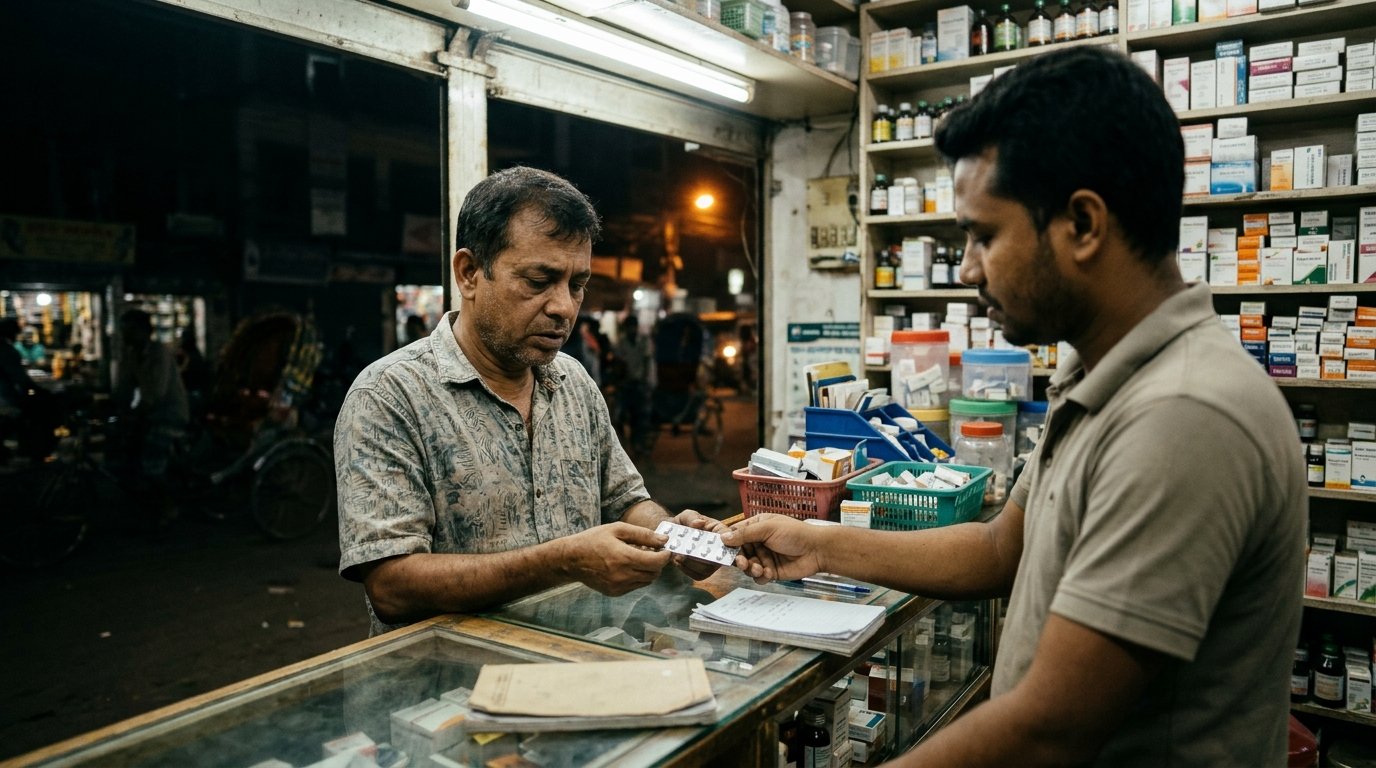
It’s 11 p.m. Your mother has a fever, doctors are hard to reach, and you have no time to spare. You walk down to the pharmacy and say, “Bhai, give me something for fever and a sore throat.” The shopkeeper hands you a strip of tablets. It costs a few takas, and the problem seems solved.
This scene is familiar to many of us. But one question deserves more attention: who actually pays for this convenience?
How much we rely on pharmacies
A survey of 450 people in Dhaka found that about 68 percent had taken medicine on their own in the past six months. Pharmacy staff were the biggest source of drug information (about 45 percent). A study in Comilla reported that nearly 74 percent of adults regularly self-medicate.
In Bangladesh, the pharmacy is often the first point of care, and sometimes the only one.
Where the problem lies
Asking a pharmacy for a headache or gas tablet is not the issue. The real risk is antibiotics.
By law, a pharmacy should have a Grade-C pharmacist, and selling antibiotics without a registered doctor’s prescription is prohibited. Reality looks different. A survey by icddr,b found that about half (50.9 percent) of customers who bought antibiotics from pharmacies did so without a prescription. Another study put the figure at 56.6 percent, mostly for “non-severe” symptoms like fever and cold or cough.
Another finding is more worrying. In one survey, only 7.3 percent of pharmacies had a pharmacist present. So how much training does the person handing you the medicine have? One study notes that most retail drug sellers in Bangladesh receive very little training, or none at all.
The risk isn’t yours alone
The first harm from the wrong drug or wrong dose lands on your own body: allergies, side effects, and the real illness getting masked. The fever goes down, but typhoid or dengue stays hidden underneath.
Then comes the bigger problem, antibiotic resistance. When antibiotics are taken unnecessarily or the course is left half-finished, germs learn to fight back. In 2019, the World Health Organization named antimicrobial resistance one of the top ten global public health threats. Speakers at a BSMMU research event warned that if things continue like this, within seven to ten years only three antibiotics might remain effective against Gram-positive bacteria and just one against Gram-negative.
An ordinary infection that clears up with one course today could become life-threatening tomorrow, for your children and grandchildren.
So should we stop going to pharmacies?
No. Pharmacies are an important part of our health system. What we need is a little awareness:
– Don’t ask for antibiotics, and don’t accept them if offered. Not without a doctor’s prescription.
– Most common colds, fevers and coughs are viral. Antibiotics don’t work on them.
– Children, pregnant women, the elderly, and people with diabetes, kidney or heart disease should not take medicine on their own.
– If symptoms don’t improve in three or four days, the fever is very high, or there is breathlessness, severe stomach pain or bleeding, see a doctor without delay.
– Ask why you’re taking a medicine, for how long, and what side effects to expect.
– Don’t reuse old prescriptions, medicine bought for a relative, or leftovers kept because “it worked last time.”
“It worked last time” may be the most dangerous sentence of all. Bodies differ, illnesses differ, and germs get smarter every day.
A pharmacy tablet may give you a little relief tonight. But every unnecessary antibiotic chips away, bit by bit, at someone else’s chance of being saved tomorrow. That someone could be your own loved one. Next time you stand at the pharmacy counter, ask yourself one question: “Do I want medicine, or do I want an answer?” If you don’t know the answer, get it from a doctor.