

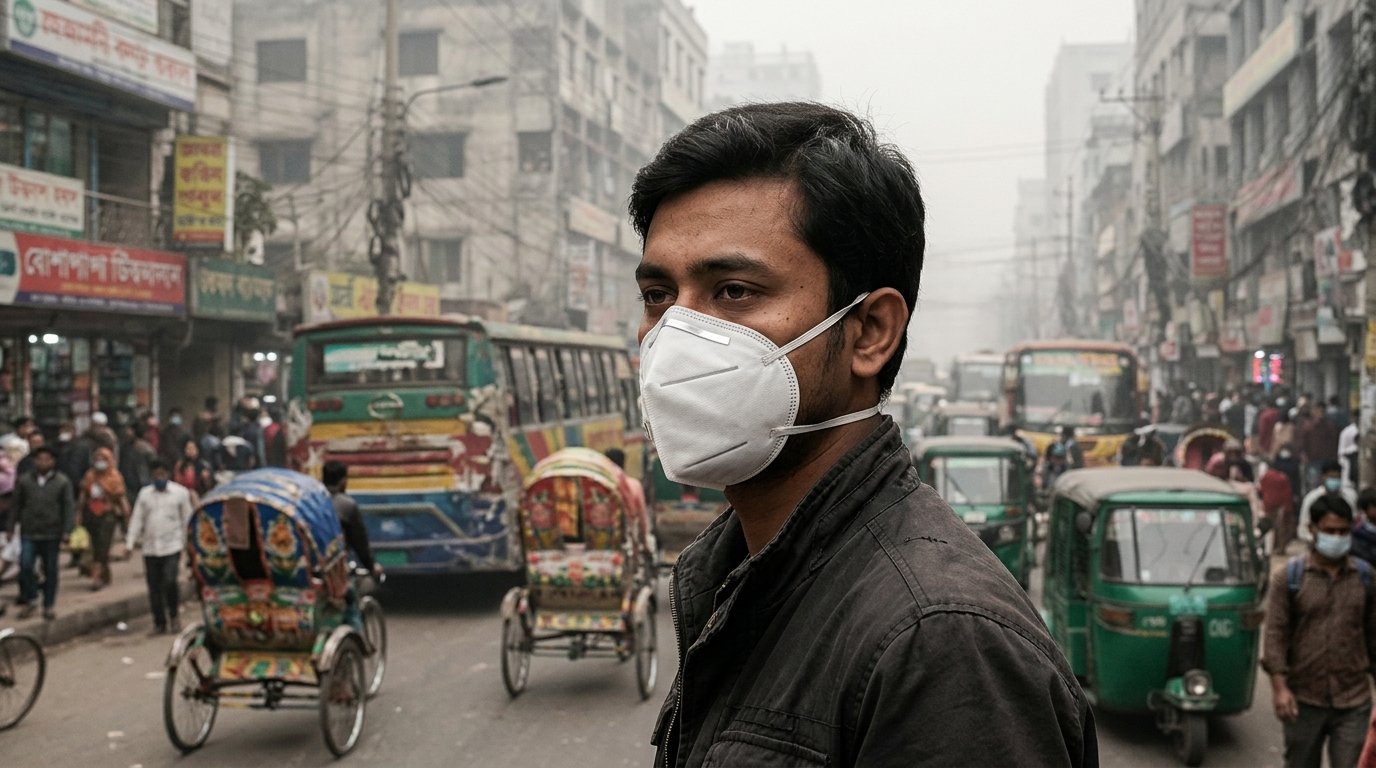
You wake up at dawn, and something gray is hanging outside your window. It looks like fog, but it isn’t. It’s dust and smoke. Out of habit, you strap a mask over your face and step out, thinking: good, now I’m protected.
But is your mask really giving you the protection you think it is?
The Enemy You Can’t See
The most harmful part of air pollution is PM2.5: particles 2.5 micrometers or smaller. The US Environmental Protection Agency (EPA) notes they are roughly one-thirtieth the width of a human hair. That’s exactly why they can slip deep into your lungs and even enter your bloodstream. The World Health Organization (WHO) estimates that air pollution is linked to around seven million premature deaths worldwide every year, from heart disease and stroke to lung cancer and asthma.
And in our part of the world, every winter, Dhaka’s air climbs into the ranks of the most polluted cities on the planet. It’s practically an annual headline now.
Not All Masks Are Equal
Here’s the first shock. The masks you see most often on the street were never designed for this job.
– Cloth masks: They catch larger dust particles to some extent, but offer limited protection against fine particles like PM2.5.
– Surgical masks: Designed mainly to stop droplets leaving the wearer’s mouth, not to shield you from polluted air. Plenty of air leaks in around the edges.
– N95 / KN95 / FFP2: These are the ones that work reasonably well against pollution. Under the US NIOSH standard, a properly worn N95 filters at least 95% of particles as small as 0.3 micrometers.
“Worn Properly” Is Harder Than It Sounds
Even with an N95, the story doesn’t end there. No matter how good the filter is, if there are gaps around the nose and cheeks, polluted air takes the easy route in. Occupational health research has repeatedly shown that when a mask doesn’t seal well against the face, the 95% on paper can drop dramatically in real life. Facial hair, loose straps, an unpressed nose clip: all of these create leaks.
It’s even trickier for children, since most masks on the market are sized for adult faces.
What Masks Can’t Do
Many people don’t know this: masks like the N95 trap particles, but not gases. Nitrogen dioxide, carbon monoxide, ozone, and volatile organic compounds from vehicle exhaust can pass through ordinary masks. So you may be protected against one part of the air and nearly defenseless against another.
There’s also the matter of time. A mask covers the few hours you spend outdoors. The other 20 to 22 hours, you’re at home, at work, or on the bus. Indoor air can be polluted too, especially with cooking smoke or dust drifting in from outside.
So Are Masks Useless?
Not at all. The truth sits between “completely safe” and “totally unprotected.” The right mask, worn correctly, meaningfully reduces your exposure, and that matters most for people with heart conditions, asthma, or lung problems. But a mask is a shield, not a wall.
What You Can Do
– Wear an N95 or KN95 when you go out, and press the nose clip to check the fit.
– On high-pollution days, avoid exercising outdoors early in the morning and at night.
– Keep windows closed at home and use an air purifier if you can.
– Check an air quality index (AQI) app before planning your day.
– If you have heart or lung disease, or are pregnant, talk to your doctor.
A mask can buy you a little time. But a person wearing a mask for a lifetime of breathing can’t be the solution. A city where a child needs a mask to walk to school, where elderly parents are afraid to stand on their own balcony, cannot be fixed with a piece of fabric. So tonight, make sure your mask fits snugly. But also learn to ask the bigger question: when will clean air become our right, not our luxury?