

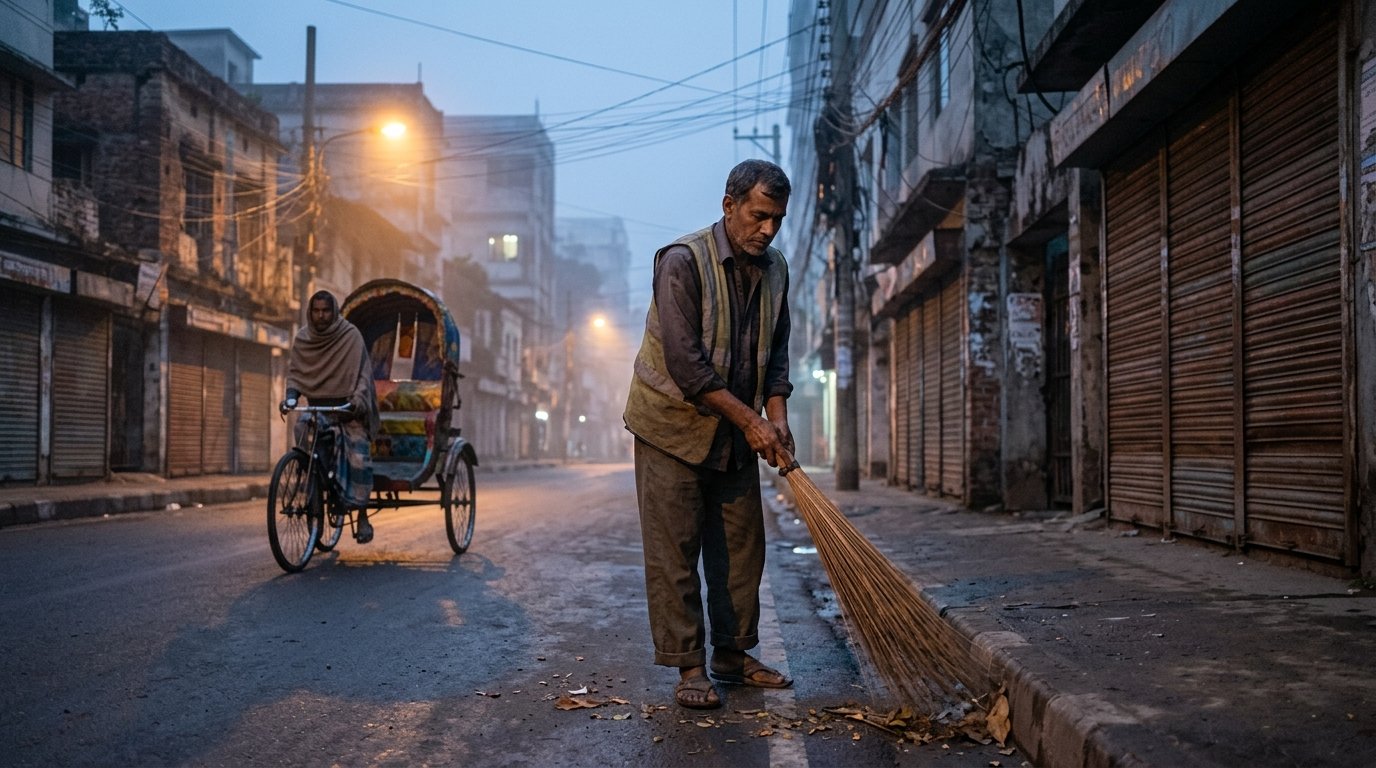
4 a.m. Dhaka’s sky hasn’t lit up yet. You’re deep in sleep, and at the street corner, a man with a broom has already started his shift. We don’t know his name. Maybe we never wanted to. But without him, your path to the office this morning would be blocked by heaps of garbage.
We See the City, Not Its Body
When we say “city,” we picture tall buildings, glittering shopping malls, and flyovers. But a city is really a living body. Water, electricity, and people flow through its veins. The people who keep that body healthy are the ones we almost never look up to see.
The numbers show the weight of their work. According to the World Bank’s What a Waste 2.0 report, the world produces about 2.01 billion tonnes of municipal solid waste every year, and that could rise to roughly 3.4 billion tonnes by 2050. In a dense city like Dhaka, thousands of tonnes of waste pile up every day. Who clears it? Thousands of cleaners, many of whom work without adequate protective gear.
The People Who Keep the City Running
Sanitation workers. A joint report by the ILO, WHO, World Bank, and others notes that sanitation workers around the world face health hazards, insecurity, and social neglect. A city couldn’t last a week without this work, yet society looks down on it more than almost any other.
Rickshaw pullers. By various estimates, around a million rickshaws run in Dhaka. The daily movement of millions through narrow lanes depends on the strength of these men’s legs. In the heat, in the rain, in traffic jams, always. When we haggle over fares, we often forget that those twenty or thirty taka put a pot on the stove for an entire family.
The night guardians. Linemen who keep the power on, pump operators, night-shift police, nurses and ward boys, the bakers before dawn. While we sleep, their work decides whether everything will be ready for us in the morning.
A Small Experiment
Imagine that tomorrow morning, all of them stop working for just one day. Garbage in the streets, clogged drains, neighborhoods without power, public transport at a standstill. In a single day, the city would grind to a halt. That’s when we’d understand that the real “infrastructure” of a city isn’t concrete. It’s people.
What Can We Do?
Big change needs policy, fair wages, and safe working conditions. But it can start somewhere very small. A simple “thank you.” Not haggling needlessly over a rickshaw fare. Putting our waste in the right place and making a cleaner’s job a little lighter. Respect doesn’t require checking someone’s job title first.
Tomorrow at dawn, when you hear the sound of a broom outside your window, think for a moment: that sound is your city’s heartbeat. We remember those who decorate the city. But those who keep it alive, remembering them is a duty that belongs to all of us. The story of a city isn’t only about its architects. It’s about its sweepers too. Their names deserve a place in that story.