

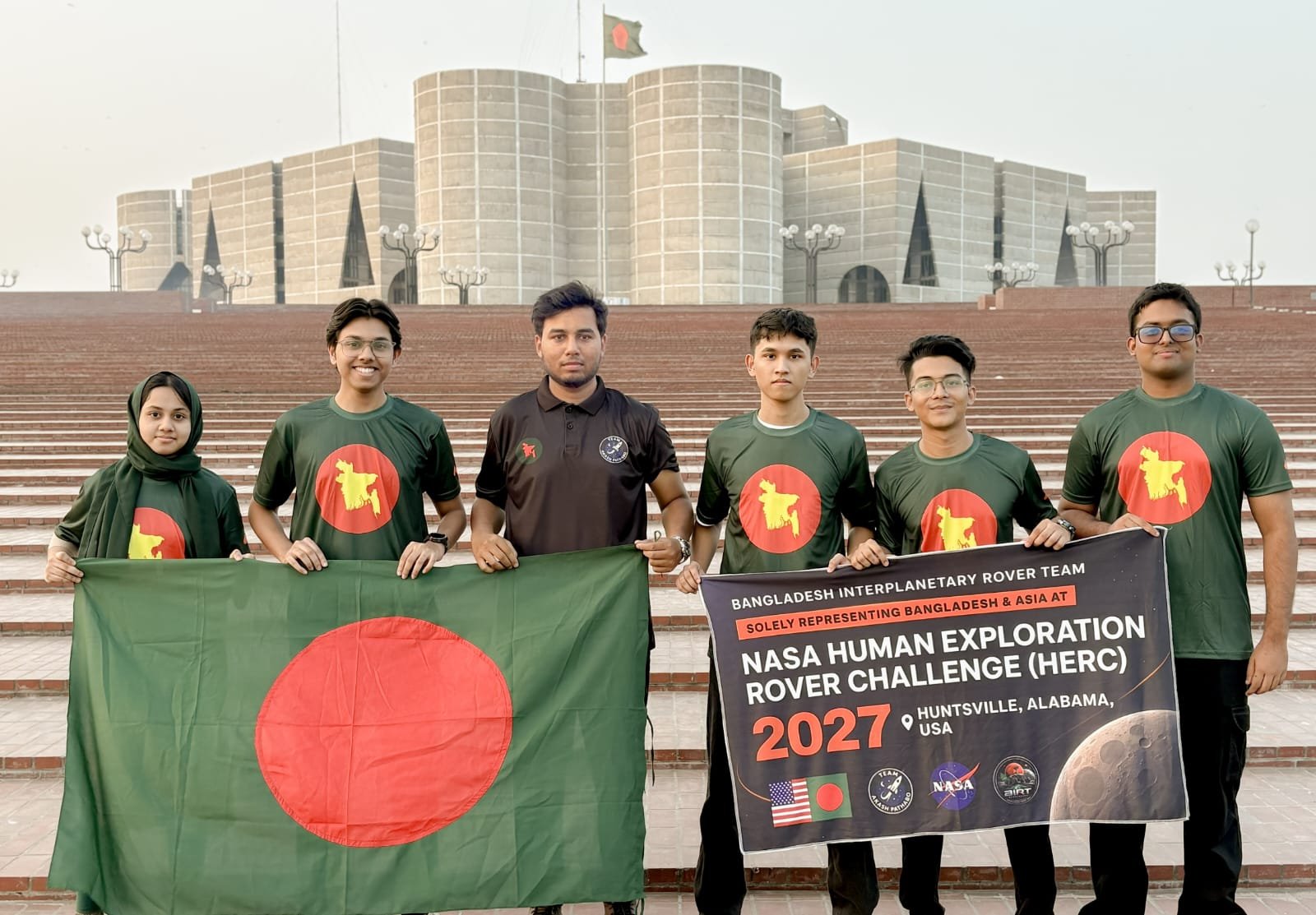
Picture it: 3 a.m. in a lab. Wires and bolts are scattered across the table, next to a cup of tea gone cold. A few young engineers are arguing over a single wheel. Dhaka sleeps outside, but their eyes are on a field thousands of miles away, where a rugged track modeled on lunar terrain is waiting for them.
This is no longer just imagination. BIRT has been selected for NASA’s Human Exploration Rover Challenge (HERC) 2027. To understand what that means, you first need to know what HERC really is.
What is HERC?
HERC is not a one-day contest. It is a nine-month challenge in which student teams design and build human-powered or remote-controlled rovers capable of crossing difficult lunar terrain. The finale takes place in Huntsville, Alabama. The 2027 event is scheduled for April 21-24 at the U.S. Space & Rocket Center.
Building the rover is only part of it. Teams submit a proposal, then pass a series of design reviews and operational readiness reviews, presenting to NASA engineers along the way. They aren’t just building a vehicle. They are learning how NASA runs real missions, hands-on. And teams must fund rover construction and travel themselves, so being selected is as much a responsibility as an honor.
Bangladesh on the world stage
This stage is not new to Bangladesh, and that is the hopeful part. At the 31st edition in 2025, teams from 35 colleges and universities, 38 high schools and two middle schools took part, coming from 20 U.S. states, Puerto Rico and 16 other nations. Among them, International Hope School Bangladesh in Uttara, Dhaka won the Ingenuity Award in the human-powered high school division. And for the 2026-27 season, St. Joseph Higher Secondary School in Mohammedpur, Dhaka has been selected in the remote-control division.
Bangladesh’s young people are no longer just spectators. They are competitors, and sometimes winners.
Why this is more than a competition
NASA itself says these challenges exist to encourage students to pursue degrees and careers in science, technology, engineering and mathematics. A country’s future depends a great deal on what its young people dare to dream. The student learning to weld a rover frame today could be tomorrow’s founder of the nation’s first space-tech startup. The girl explaining her design to a NASA panel today could become a role model for an entire generation.
On the day BIRT’s rover rolls onto the field in Huntsville, the ground beneath its wheels will be American, but the flag will be red and green. Win or lose, this team will answer everyone who once asked, “Can we really do this?” The Moon is far away. That much is true. But every great journey begins with a small wheel turning. Bangladesh’s wheel has started to turn.