

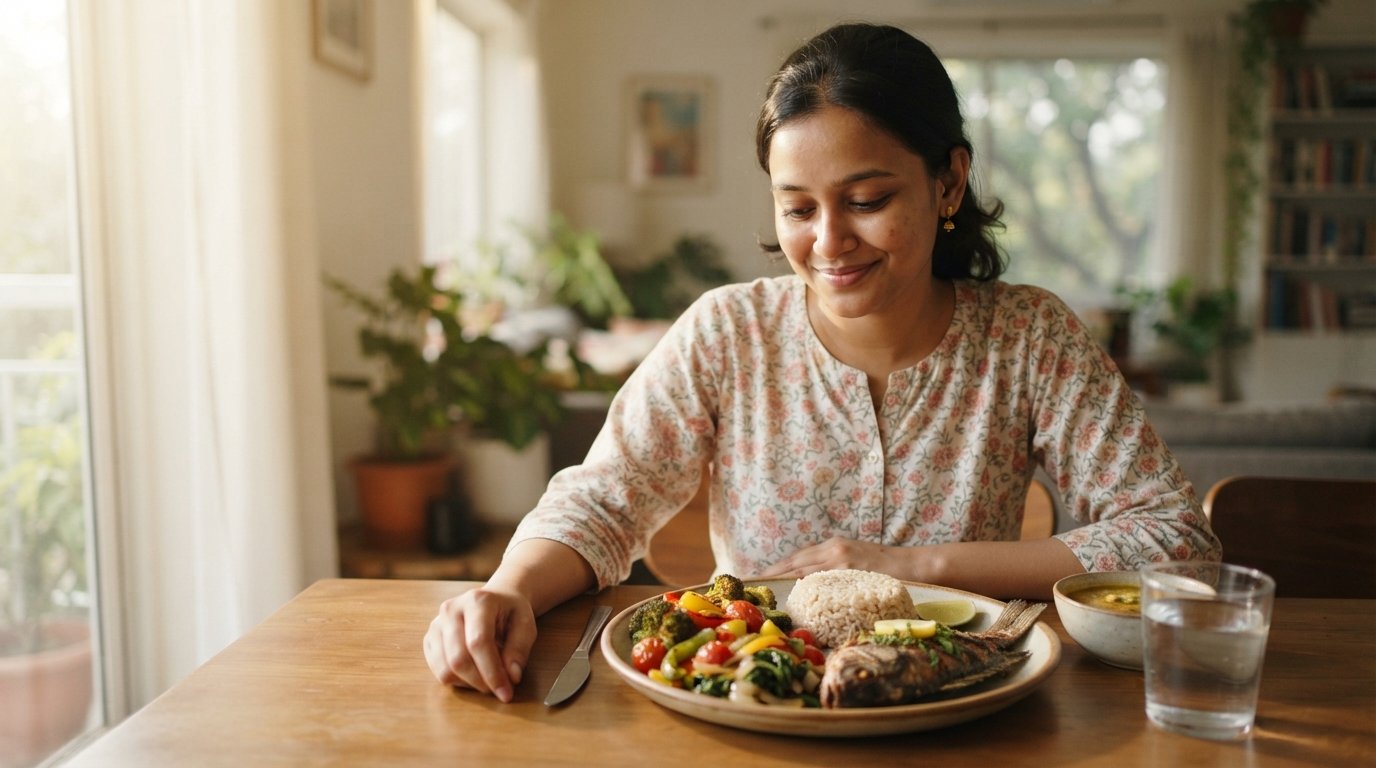
Do you know what happens to the person who wears themselves out counting calories every morning? Eventually, they start dreading food itself. Busy holding onto a number, they forget to notice what the food actually tastes like, or what their body is really asking for.
Many of us assume that staying healthy means calories must be counted — punch in the numbers, hit the target, then eat. But here’s the reality: for most people, this approach doesn’t hold up long-term. Research shows that a large share of people who track calories strictly burn out within a few months and drift back to old habits. That’s because remembering numbers is a chore, but eating was supposed to be a pleasure.
So what’s the alternative? Nutritionists now point to a much simpler idea — the “plate method.” Here, it’s not the numbers that matter, it’s the proportions.
Divide your plate
Picture your plate split into four parts:
– Half the plate — vegetables and fruit. Colorful, fiber-rich, and filling without piling on calories.
– A quarter — protein. Fish, eggs, chicken, lentils, or tofu — supporting muscle and keeping you full longer.
– A quarter — carbohydrates. Rice, bread, or potatoes — your main energy source, in moderation.
– A small amount of healthy fat — nuts, olive oil, or avocado — essential for hormones and brain function.
Harvard’s T.H. Chan School of Public Health has pointed to a similar ratio — the emphasis is on getting the balance right, not hitting a specific number.
Eat with attention
Arranging the plate well isn’t enough on its own. Studies show that people who eat slowly and mindfully — away from phones or TV — naturally eat less and feel more satisfied. It takes the brain roughly 20 minutes to register the “I’m full” signal. Eat in a rush, and that signal never gets the chance to arrive.
Listen to your body
Learning to recognize the feeling between hunger and satisfaction — that’s the real skill. Research on intuitive eating suggests that people who learn to trust their body’s signals end up with a far more stable, lasting relationship with food.
Every body is different. An app’s number will never understand today’s exhaustion, last night’s poor sleep, or the pressure you’re under right now. But your body does.
So starting today, look at your plate instead of a number. Notice the colors, match the proportions, and — most importantly — enjoy it. Because wellness was never an equation. It’s a relationship — with your own body, one plate at a time.