

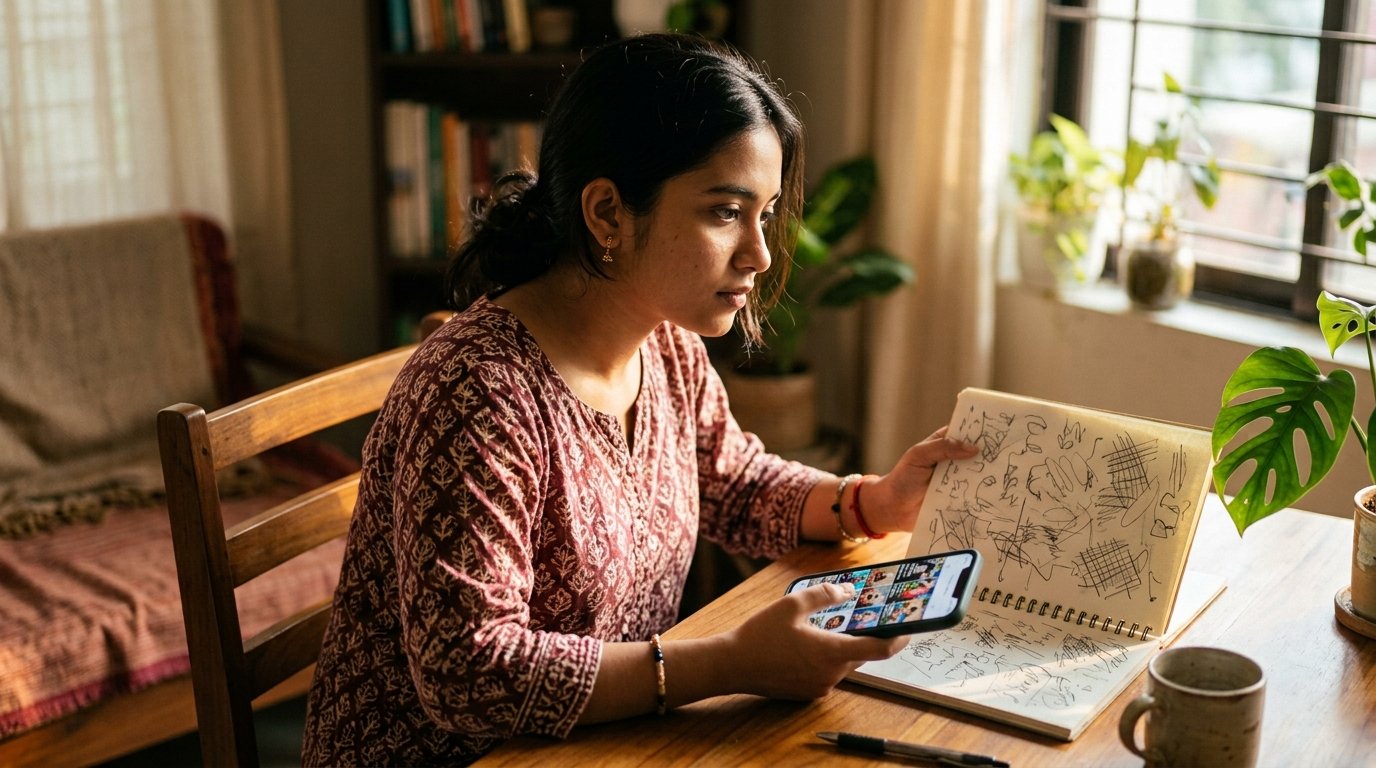
When was the last time you sat with your own idea, without your phone within reach? Try to think back. Most people freeze right at this question. Because right in the middle of thinking, the hand reaches for the phone on its own, the scrolling starts, and whatever idea was just being born quietly disappears somewhere.
We see thousands of photos, videos, and opinions from other people every single day. You’d think all that input would spark even more ideas in our heads. But reality can move in the opposite direction too. The real question is, is social media actually taking our creativity away?
What research actually says, the answer isn’t that simple
A study published in Information Systems Research by Hildebrand and colleagues found that when people get feedback from a community on something they designed themselves, their creativity drops. The reason is simple. Trying to keep in mind what others might like pulls people away from their own original thinking, nudging them toward something safe that everyone will approve of instead.
But the full picture isn’t that one sided. Researchers at the University of Rochester found that people generally follow others whose ideas already resemble their own. The result is the same kind of thinking circling back again and again, leaving less room for anything new to get in. According to the researchers, if platforms introduced us to people with different ways of thinking instead of people similar to us, creativity could actually increase.
Another important distinction came out of a recent study, which found that how time is spent on social media is the real factor. Just scrolling, meaning passively watching other people’s content, weakens attention and flexible thinking. But when people create content themselves or engage in meaningful conversation, the effect flips, thinking actually opens up.
So where’s the actual problem
The problem isn’t social media itself. The problem is how we’re using it. Nonstop scrolling puts the brain into a passive mode, one where there’s no room left for your own thinking to happen. A study on Gen Z populations found that the mind wandering caused by excessive scrolling, that drifting away of attention, can actually weaken creative output.
At the same time, it’s also true that the more variety in ideas you’re exposed to, the more your creative potential grows. A 2019 study by Acar and colleagues found that time spent on social media can improve the quality of creative work, though it doesn’t affect the quantity much. In other words, spending more time isn’t the problem, how that time gets used is what actually matters.
What keeps creativity alive
Cutting back on passive scrolling and actively trying to create something, following people outside your own usual views, and setting aside at least a little time every day to think alone without your phone, these small habits are what actually make the difference.
Social media itself isn’t the enemy, and it isn’t a friend either. It’s a tool, and what it produces depends entirely on how someone uses it. If all you do is scroll, your mind will eventually run empty. But if you create something yourself, talk to people who think differently, and every now and then put the phone down to sit alone and think, this same platform can become the biggest ally your creativity has. The difference was never in the platform, it’s in your habits.