

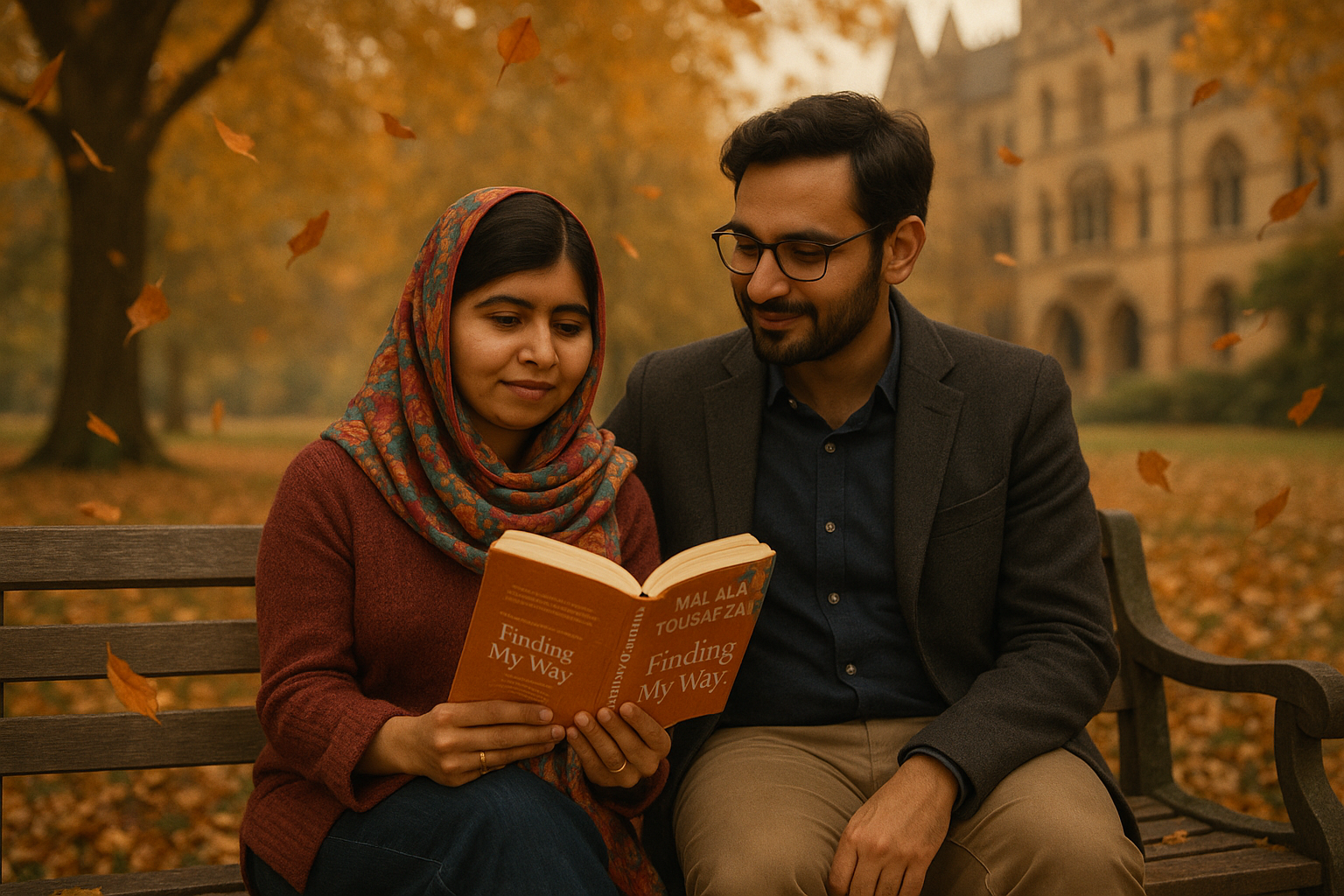
When we hear the name Malala Yousafzai, we typically think of a courageous teenager who stood against the Taliban for women’s education rights. But her recent memoir ‘Finding My Way’ reveals a completely different side of Malala – an ordinary young woman who fell in love and struggled to balance tradition with modernity in the most intimate corners of her heart.
When Two Worlds Collide
At 21, Malala found herself living an extraordinary double life. On one hand, she was just another Oxford University student chatting with friends and enjoying campus life. On the other hand, returning home meant transforming back into a dutiful Pashtun daughter, guardian of ancient traditions. This dual existence became even more complicated when Assar Malik, an official from the Pakistan Cricket Board, entered her life.
Malala herself acknowledged that according to Pashtun culture, any interaction with men before marriage was strictly forbidden. Even meetings had to occur in the presence of family members. But she had already broken all the rules. Reflecting on this internal conflict, she wrote: “I wanted to scream, ‘Why are you thinking about marriage? Can’t I live my life like other 21-year-old college students?'”
The weight of living between two identities—the pure Pashtun daughter her parents knew and the fun-loving girlfriend Assar had come to adore—was becoming increasingly unbearable. She described feeling as though these two separate versions of herself were constantly at war, never finding peace in either world.
The First Family Meeting: A Carefully Orchestrated Performance
The day Assar Malik first met Malala’s family was like watching a precisely choreographed play. Every minute was calculated: arrive by train in Birmingham at 11:45 AM, lunch at the house at noon, and departure back to London at 1:00 PM sharp. Malala thought to herself that surely nothing could go too wrong in just one hour.
But reality proved more chaotic than her carefully laid plans. Her father had mistakenly invited seven additional guests that same day, creating a bustling garden barbecue atmosphere that felt more like a community gathering than an intimate family introduction. Malala’s mother positioned herself strategically in a chair beneath a tree, observing everyone—but especially Assar—with the keen eye of a protective parent.
The interrogation began almost immediately. “Do you speak Pashto?” her mother asked. Assar, showing admirable courage, attempted a few sentences. While Malala’s mother wasn’t particularly impressed, she seemed somewhat satisfied that he had at least made the effort. Meanwhile, Malala felt her anxiety mounting as she watched her two worlds collide in real time.
Fortunately, Assar found his comfort zone discussing grilling techniques with her father and the other guests. He encouraged her younger brother Khushal with his studies and even engaged in beatboxing with little Atal. These small moments of connection seemed to ease some of the tension, but Malala remained acutely aware of the performance they were all giving.
When the hour was up and she called a car for Assar’s departure, Malala whispered “Sorry” in his ear as he left. As soon as he was gone, she felt a weight lift from her chest. She could finally breathe normally again because her two separate identities had returned to their respective corners. But this relief was short-lived—she couldn’t fathom how she would spend the next few weeks without him.
The Medical Journey: Fighting on Multiple Fronts
The day after Assar’s visit, Malala found herself on a flight to Boston with her parents, heading to Massachusetts Eye and Ear to meet Dr. Tessa Hadlock. Dr. Hadlock, a Harvard Medical School professor and pioneer in facial paralysis treatment, was overseeing Malala’s complex cross-facial nerve graft surgery—a procedure that, if successful, would restore more movement to the left side of her face.
Initially, Malala had resisted this surgery. She knew it meant spending three consecutive summers in hospitals and rehabilitation centers. But her parents desperately wanted to erase the traumatic memory of first seeing her in Birmingham’s hospital—the sunken eye, the paralyzed face. They also wanted to silence the relatives and online trolls who cruelly reminded her, “You were so beautiful before you were shot.”
During the flight, a message from Assar appeared on her phone: “Did your parents say anything about us?” Malala replied with brutal honesty: “They’re somewhat worried.” Her parents feared that someone might secretly photograph them or that word of their relationship might spread through their circle of friends. They wanted her to end things with Assar before any scandal could emerge—a request she had no intention of honoring.
The tension with her parents over her relationship added another layer of stress to an already difficult time. Normally, she would sit beside her father on flights, talking for hours about everything and nothing. This time, however, she pulled a blanket over her face and pretended to sleep, unwilling to engage in conversations that might lead back to the subject of Assar.
Fortunately, the surgery was successful. When she woke up, sunlight streaming through the hospital window filled her body with a comforting warmth. She thought to herself, “You made it through.”
An Unforgettable Evening at the Dorchester
Upon returning to London, Malala met with Assar for what would prove to be one of the most pivotal conversations of her young life. Before his departure back to Lahore, they shared dinner at a Cantonese restaurant in the Dorchester Hotel. Despite her face still being swollen from surgery, Assar looked at her with the same admiring smile he had given her at the beginning of summer when she wore that “sex bomb” dress that had so amazed him.
For months, they had allowed their relationship to exist without defining it, simply enjoying each other’s company and letting things unfold naturally. Malala had preferred this ambiguity, but the recent weeks apart had intensified her feelings, making her desperate to understand where they stood.
That evening, Assar opened his heart completely. “I’ll miss you terribly when I leave,” he said. “Not seeing you even once a week will feel so empty. You know, the second time we met, I told you I was looking for a long-term relationship.” He paused, and Malala felt her heart racing, wondering what would come next. Was he about to propose, or was this goodbye?
“To be honest,” he continued, “I’d be ready to marry you tomorrow if you wanted. But I don’t think it’s right to propose to you now. It would be unfair to put that pressure on you. You’re still so young. You’re still changing every day, still figuring out exactly what you want from life.”
His words were so considerate that Malala couldn’t wait to acknowledge them, but they also frustrated her. “Do you think I don’t understand my own feelings because I’m young?” she challenged. “How did you figure out at 29 that you loved someone?”
Assar explained that he had asked himself certain questions: “Is spending time with her what makes me happiest? Do I enjoy talking with her for hours? Do I trust her? Do I want to kiss her in the Dorchester Hotel cloakroom?” This last question made Malala blush furiously, leaving her momentarily speechless.
Gathering her courage, she attempted to define their relationship: “So… for now… let’s say we’re in an open relationship, but from your side, it’s something more serious.” Assar laughed so loudly that people at neighboring tables turned to look at them.
The Pain of Secrecy
But then Assar shared the deeper pain he had been carrying. “No one wants to be the ‘secret person’ in someone’s life,” he said, “especially when I want everyone to know how extraordinary you are. I want to take you on beach vacations, fill my phone’s gallery with pictures of us together. But I don’t know when that will happen, or if it ever will.”
When Malala explained that the secrecy was meant to keep her parents calm and prevent scandal, Assar offered a more profound insight: “I think you keep this secret because you’re still not sure what you want from life, or what you want from me. And that’s okay! Because this uncertainty doesn’t disappear with age. Life doesn’t come with road signs. Nobody can live with complete certainty—there’s always the risk of making wrong decisions or having your heart broken.”
His mature perspective both comforted and unsettled her. She found herself pulling at her sleeves, feeling unprepared for the first time all summer.
A Difficult Decision
Feeling overwhelmed, Malala made what seemed like a practical proposal: “Can we take a temporary break? Just until I finish my Oxford chapter. Then we can start again from here next June and see where it leads.”
Assar smiled sadly. “I don’t think you can ‘pause’ feelings like that. But I’ll try, for you.”
This exchange revealed a great deal about both of them—Malala’s need to prioritize her academic career and future responsibilities, and Assar’s willingness to respect her decision, despite his own emotional needs. It showed a young woman trying to apply logic to matters of the heart, and a man mature enough to love someone enough to let them find their own way.
“I Love You” – A Whispered Farewell
In a dimly lit corner of the hotel lobby, they stood to say goodbye. As Assar gently embraced her, Malala whispered, “I love you.” These words contained all the emotion of a young woman’s heart—someone simultaneously struggling between tradition and modernity, between love and duty, between what she wanted and what was expected of her.
That whispered confession in the hotel lobby represented more than romantic love; it was an acknowledgment of the complexity of her feelings, the difficulty of her situation, and perhaps most importantly, her recognition that some things are worth fighting for, even if the battle must be fought quietly and over time.
A Universal Story of Modern Love
Malala Yousafzai’s love story transcends her individual experience to become a mirror reflecting the struggles of countless young people in our modern world. Her journey illuminates the challenges faced by those who must navigate between:
Cultural expectations and personal desires. Malala’s struggle with Pashtun traditions while pursuing her own path in love represents millions of young people worldwide who must balance respect for their heritage with their desire for self-determination.
Family obligations and individual happiness. Her parents’ concerns about scandal and reputation versus her need for authentic relationships speak to a universal tension between family loyalty and personal fulfillment.
Public identity and private life. As a globally recognized figure, Malala faced the additional burden of knowing that her personal choices could become public spectacles, affecting not just herself but her family and her cause.
Career ambitions and romantic relationships. Her decision to prioritize completing her Oxford education reflects the modern challenge of balancing professional goals with personal relationships—a dilemma particularly acute for ambitious young women.
Lessons in Love and Growth
What makes Malala’s story particularly compelling is its honesty about the messiness of young love. There are no easy answers, no clear right or wrong choices. Instead, there’s the reality of two people trying to navigate complex emotions while dealing with external pressures that most couples never face.
Assar’s patience and maturity shine throughout the narrative. His willingness to wait, to respect Malala’s need for time and space, and to love her without demanding immediate commitment demonstrates a rare understanding of what genuine love requires. His insight that “nobody can live with complete certainty” and that the risk of heartbreak is always present reveals an emotional intelligence that made him worthy of Malala’s eventual trust.
Malala’s own growth throughout this period is equally remarkable. Her initial desire to keep the relationship secret gradually gave way to a deeper understanding of what she wanted from life and love. Her willingness to eventually embrace vulnerability—culminating in that whispered “I love you”—showed her evolution from a protected young woman to someone ready to take emotional risks.
The Triumph of Patient Love
The story reaches its real conclusion not in the hotel lobby but in November 2021, when Malala and Assar married after several years of courtship. Their eventual union validates the difficult choices they made during those early days—Malala’s insistence on finishing her education, Assar’s patience with secrecy and uncertainty, and both of their decisions to prioritize long-term compatibility over immediate gratification.
Their marriage represents more than a personal victory; it’s a testament to the possibility of honoring both tradition and personal choice, of respecting family while asserting independence, and of finding love that grows stronger through obstacles rather than weaker.
A Story for Our Times
In an era of instant everything—instant communication, instant gratification, instant relationships—Malala and Assar’s story offers a different model. It suggests that the best things in life often require patience, that love worth having is love worth waiting for, and that sometimes the greatest act of love is giving someone the space and time they need to become who they’re meant to be.
Their story also speaks to the particular challenges facing young women today who are trying to balance ambition with romance, independence with family loyalty, and public responsibility with private happiness. Malala’s journey shows that it’s possible to have it all, but not necessarily all at once, and not without making difficult choices along the way.
Perhaps most importantly, their story humanizes someone who has become an icon. It reminds us that behind every public figure is a private person with the same hopes, fears, and desires that we all share. Malala Yousafzai may have won the Nobel Peace Prize, but she also experienced the universal human experience of falling in love, facing family pressure, and trying to figure out what she wanted from life.
In sharing these intimate moments from her life, Malala has given us something precious: a reminder that courage comes in many forms, that growing up is a process that continues well beyond our teenage years, and that sometimes the most important battles we fight are the quiet ones in our own hearts.