

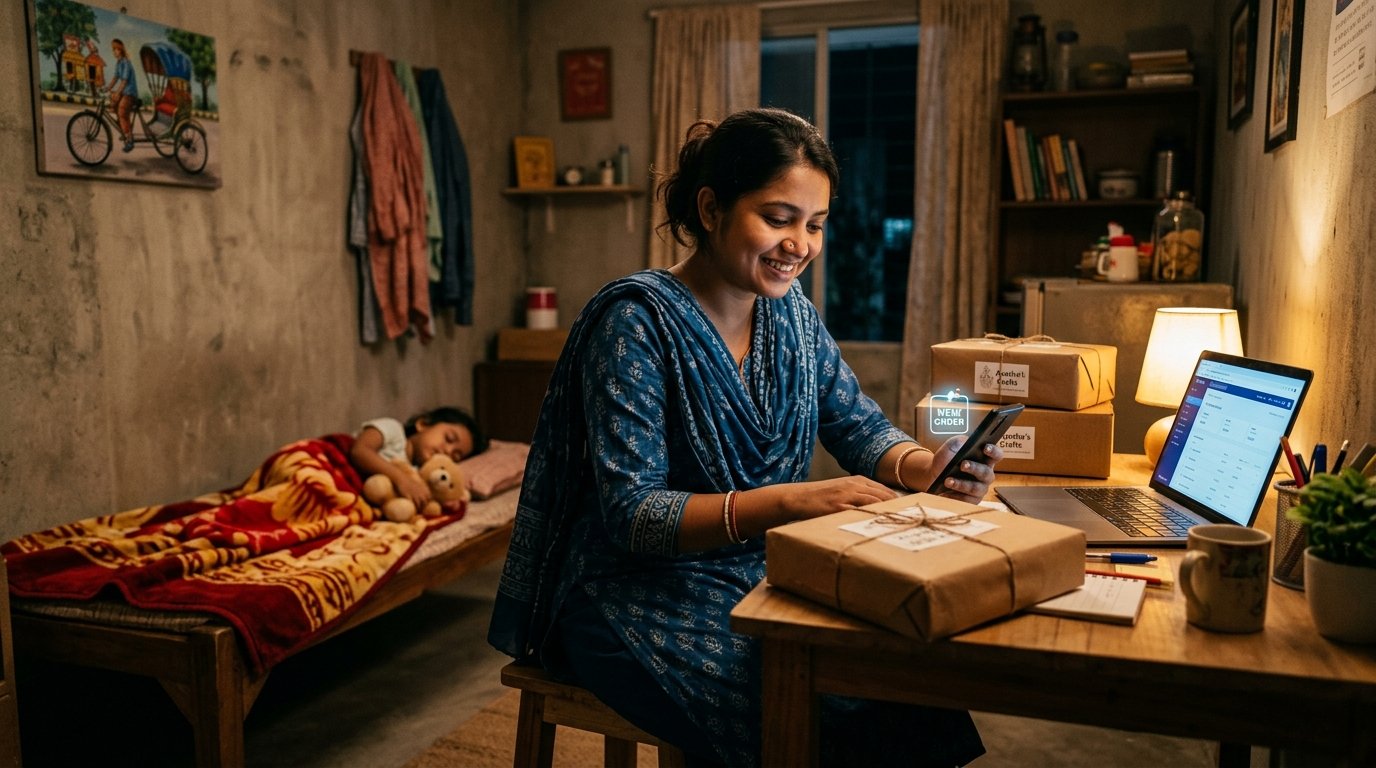
It was almost 11 p.m.
In a small apartment in Mirpur, Dhaka, Ritu sat quietly, staring at her phone. A notification had just popped up on her Facebook page—another new order. Her child had a fever, household chores were still waiting, yet a smile appeared on her face. Because that little Facebook page had become one of her family’s most important sources of income.
Ritu isn’t alone. Across Bangladesh, millions of people have seen their lives transformed by digital platforms.
A New Home for Small Businesses
There was a time when starting a business meant renting a shop, finding warehouse space, putting up a signboard, and investing a significant amount of money. Today, that reality has changed. With nothing more than a smartphone and an internet connection, anyone can start a business.
More than 300,000 sellers in Bangladesh now use Facebook Pages as their primary storefronts. In 2025, the number of active Facebook users in the country surpassed 67.1 million, with an additional 14.2 million users joining in just one year.
These numbers represent more than the popularity of social media. They represent a massive marketplace that is now only a click away from every entrepreneur.
The Biggest Transformation
Digital platforms are no longer just places to sell products. They have evolved into complete business ecosystems, allowing entrepreneurs to showcase products, receive orders, accept payments, communicate with customers, and manage their businesses—all in one place.
At the heart of this ecosystem lies digital payment.
Bangladesh now has more than 80 million verified bKash users, making it the country’s most widely used mobile financial service. Not long ago, one of the biggest barriers to online commerce was the lack of a trusted payment system. Services like bKash and Nagad have helped remove that barrier.
Today, 78 percent of all e-commerce transactions in Bangladesh take place on mobile devices—the highest share in South Asia. Business has truly become something that fits in the palm of your hand.
How Big Is the Opportunity?
Bangladesh’s e-commerce market surpassed US$3 billion in 2025 and is on track to reach US$4 billion by 2026.
Even more promising, the number of online shoppers is projected to exceed 15.9 million by 2029—an increase of nearly 48 percent compared to 2024.
Think about what that means. This is an enormous and rapidly expanding market. And unlike before, access to this market is no longer reserved for large corporations.
But the Opportunity Isn’t Equal
The reality is that not every small business is benefiting equally.
More than 96 million people in Bangladesh still remain outside the digital world, with the gap being particularly significant in rural areas.
And having internet access alone isn’t enough. Entrepreneurs need to understand digital marketing, product photography, content creation, customer service, and online business management. These are skills that take time to develop.
But those who have mastered them are in a strong position. Today, one in four online shoppers says that social media content and customer reviews play a major role in their purchasing decisions. In other words, quality content and a trustworthy online presence have become some of the most valuable business assets.
What Has Really Changed?
In the past, a small business could usually reach customers only within its neighborhood or, at best, its city. Today, an artisan in Rajshahi can sell handmade products to customers in Dhaka. A woman entrepreneur in Sylhet can build a customer base across the entire country through nothing more than a Facebook page.
Breaking down these geographical barriers is perhaps the greatest gift digital platforms have given to small businesses.
Business is no longer simply a game of capital. It has become a game of ideas, hard work, and digital presence.
That order Ritu received at 11 p.m. wasn’t just another sale. It was proof that opportunity is now closer than ever before. The door is open to everyone—you simply need to know how to walk through it.